
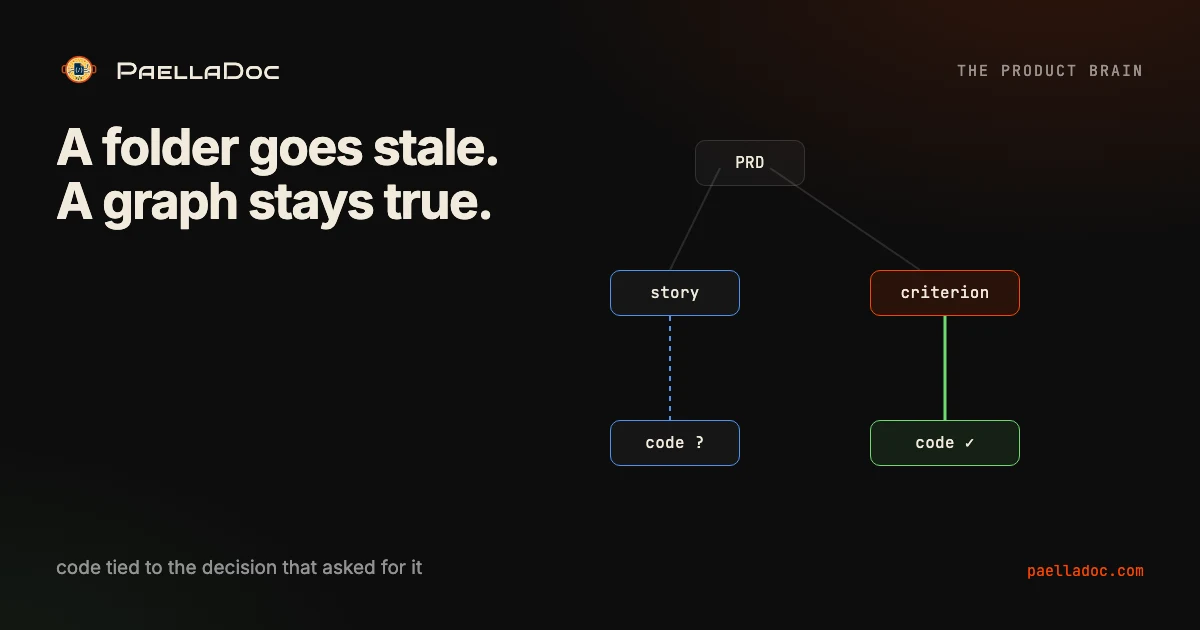
PAELLADOC treats software development as one continuous product system. The same intent should survive discovery, specification, implementation, validation and release.
Product intent is the source
The product brief is not disposable input for a code generator. It establishes users, problems, constraints and outcomes. User stories and acceptance criteria refine that intent into testable behavior.
When the definition changes, the system should expose what else may now be affected.
Evidence governs decisions
Experiments are connected to the assumption they test. Their outcomes become decision evidence rather than disappearing into meeting notes or a separate analytics tool.
This creates a legible chain:
assumption → experiment → evidence → decision → product increment
Delivery is part of product work
Roadmaps and sprints are not isolated planning documents. They are execution views over the same product definition. Work can be evaluated against acceptance criteria and linked back to the decision that justified it.
Code joins the same graph
When a repository is connected, PAELLADOC maps source structure and implementation evidence into the product knowledge graph. A developer can move from a feature or acceptance criterion toward the relevant code, and from a code area back to the product behavior it serves.
The graph is the product memory
Chats are useful for interaction; graphs are useful for continuity. PAELLADOC uses durable, connected artifacts so the system does not have to reconstruct the product from a fresh prompt every time.
The result is context that can be inspected by a product manager, a builder working without code and a developer working directly in the repository.