
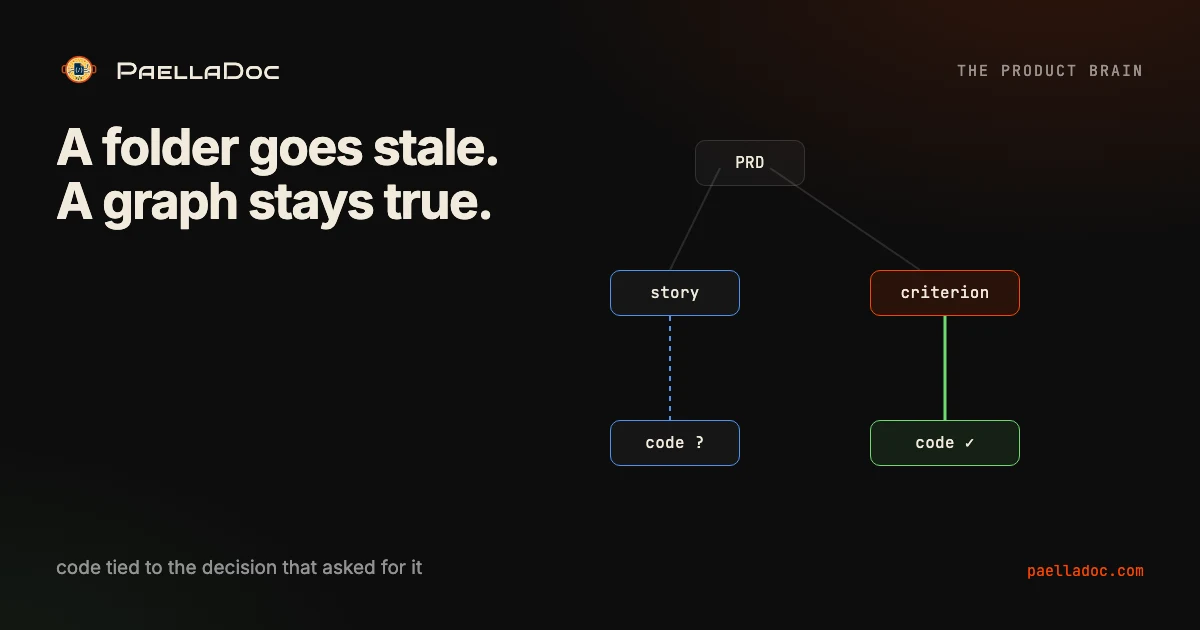
PAELLADOC works with structured product artifacts, but the value is not the document format. The value is that every artifact has a purpose, a lifecycle and explicit relationships to the rest of the product.
Brief and product definition
The brief captures the product boundary: target users, the change the product should create, constraints, success signals and unresolved assumptions. It gives every later artifact a shared origin.
User stories and acceptance criteria
User stories describe useful behavior from the user’s perspective. Acceptance criteria turn that behavior into a definition that can be challenged before implementation and verified after it.
Useful criteria are observable, unambiguous and tied to a real story—not a checklist generated after the code exists.
Assumptions, experiments and evidence
An assumption describes what must be true for the product direction to work. An experiment specifies how to learn. Evidence records what happened and whether the result is strong enough to change a decision.
These artifacts preserve the reasoning behind product changes.
Decisions and roadmap
Decision records connect evidence to an explicit choice. Roadmap increments then express the outcomes worth pursuing, with the decision and product definition still available as context.
Sprint and delivery work
Sprint items are implementation slices of the roadmap, linked to stories and acceptance criteria. Their completion should produce evidence: tests, working behavior, review outcomes or release artifacts.
Architecture, code and knowledge graphs
Technical decisions, repository structure and code-derived relationships join the product graph when implementation begins. PAELLADOC can then connect a product behavior to delivery work and to the code that realizes it.
The traceability chain
The core chain is deliberately simple:
brief → story → acceptance criteria → decision → increment → code → evidence
Not every project needs every artifact on day one. Start with the smallest chain that lets the team explain what is being built, why it is worth building and how it will be judged.